Showing posts with label the end. Show all posts
Tuesday, July 16, 2013
The Fattest Armor
Skinny poets last forever, but fat poets last only as long as the world - just ask Joseph Brodsky. With his blue eyes and impeccable deadpan (which sounds in Russian like nothing else but in English like John Shade) he did not invent, but almost certainly did extend the role of the poet as tourist.
Poets have always been tourists, of course, but Brodsky made the pose cool or rather interesting: productive, at least of poetry. His best poems are basically just him walking around looking at stuff, and his best lines a combination of super-retweetable aphorisms and typically Russian mini-conversations with things that most people would assume to be voiceless - things like salt-shakers, picnic tables, beaches. Here, for example, from Lullaby of Cape Cod:
"A giant clock on a brick tower
rattles its scissors. The face is drenched with sweat.
The streetlamps glisten in the stifling weather,
formally spaced,
like white shirt buttons open to the waist."
(translation by Anthony Hecht and probably Brodsky himself too - see Daniel Weissbort's whiny but illuminating journal of a translator, From Russia with Love)
Now maybe it's the summer, which is after all a great season for walking around and looking at things, and then kind of transforming those things into other things or just picking them up and putting them in your pocket, but I love this kind of stuff. It's the Euro of poetry: a terminally uncool super-currency that lacks in specifics but nonetheless opens everything up, at least for a little while. Its ethics are pragmatic, which is boring but at least honest: what it promises is that everything can be interesting, the same way that the American Dream promises that everyone can be rich. I have a sense that it is doomed, not just because its various CEOs (some of my favorites: Derek Walcott, Les Murray, Seamus Heaney) have strip-mined their sources, but because there is a point where plentitude itself becomes a ponzi scheme and we have to blow the whole thing up. Why do we have to blow the whole thing up? I don't know. Maybe because you can only offer band-aids for so long until people start wanting a Rimbaud to come in and reinvent the universe. Maybe because we just have to.
As a Petersburger, meaning as a native of a city that was created, Brodsky had an intuitive grasp of apocalype. Things had a beginning, and we can remember that beginning therefore they would have an end, and we will see it. Here he is talking to Solomon Volkov:
"Once Susan Sontag said that a person's first reaction in the face of a catastrophe is basically to ask, 'Where did the mistake occur here? What should have been done to take this situation in hand? So that it doesn't happen again?' But there is another, alternate behavior, she says: to let the tragedy steamroll you, to let it crush you. As the Poles say, 'to lie down under it.' If you ever do manage to get back on your feet after that, then you rise up a different person. The phoenix principle, if you like." (Conversations with Joseph Brodsky, p. 45)
Brodsky's calm in the face of disaster helps explain his fatness, I think - explain and excuse it, since there's a subtle but important difference between Nero fiddling and the Wandering Jew. Both men know they're going down, both are slightly detached from the disaster going on around/within them; but the WJ has his eyes open. He understands himself as a witness, and the particular end really just one more version of a thing that has been happening over and over again, as it should. Recently I was arguing with a couple of Russian friends about this. I said that the same thing happened in the US, and that if you squinted you could still see the blue and grey uniforms on TV commentators and supreme court justices - but Svetlana stuck a finger down into the air between us as it were a gigantic cauldron she was stirring. History for Americans moves around, but up too, she said. A spiral. But in Russia it is only round and round.
One good thing about being strapped to a wheel of course is that it allows you to shake hands with your predecessors - in Brodsky's case, with the great amor fatist Alexander Pushkin. For me, Pushkin is the key to Brodsky - not to understanding him (Brodsky is not the kind of poet you have to "understand"), but to liking him. Read on its own, Lullaby of Cape Cod is good, but read as a sequel or fourth season to Eugene Onegin or the Journey to Arzrum it starts to feel like necromancy. It's like, Brodsky's saying "Watch me be Pushkin for a few minutes, meaning watch me try and reconcile myself to the brevity/limitedness of life by throwing language at everything. Because I'm honest, and because I'm a poet, it will not stick everywhere - it will not even stick in the places it did before, and this will be why watching me is worth your while, since by doing so you'll get some tips on which parts of the world are still poetic and thrilling and which parts have been exhausted for now."
The "for now" is an important part of it. In his brilliant biopic of Brodsky, the animator of genius Andrei Khrzhanovsky reminds us of the advantages a city dweller has when it comes to remembering: namely, that with a city, you can see the same relatively small space change, age, disappear, be reborn, in a way that, ok, may be possible for someone who grows up on a farm but is not really possible for someone who grows up all over the place. I have literally not seen the continents, let alone countries, I lived on between the ages of six and fourteen since I left them. So Brodsky's preference for time over space possesses a certain... fascination for me. Actually, it makes me jealous and a little suspicious of his "exile" - for is it really possible to be an exile when you consider the entire earth to be a single huge ship sailing through time? Or is it only possible then?
To put this another way: Oh America! Oh Olson, with his "I take SPACE to be the central fact to man born in America" - as if spelling it in Poundian caps makes ANY DIFFERENCE! I can hear Brodsky chuckling at our insistence that time needs to be dealt with only in its congealed form (like believing in air conditioners but not electricity). Maybe that's why we're so lonely, and so communal - for lacking any handshake with ancestors we cuddle in the boat, anxious for the brown-eyed handsome man to come and make experience not important any more, and the skinny man therefore king.
Wednesday, April 28, 2010
The End: a Paleontology
I. Petrified Metaphors
Ponder, if you will: no human being on earth, alive or dead, has ever seen a dinosaur.
In his fantastic exploration of millennial thought, The Sense of an Ending, British literary critic/experimental essayist Frank Kermode examines the concept of "spatialization" in literary criticism, first described by Joseph Frank. Frank's idea, roughly paraphrased by Kermode, seems to be that, while we read a book once "in time", we continue to experience it - through either memory or rereading - in space. Personally, I find this metaphor a little difficult to wrap my mind around (can time and space be isolated like that? Don't we always experience things in both time and space? Could I somehow interact with my living room in a way that doesn't require my moving through time as well? Could I spend an hour outside of space?). What seems crystal clear, however, is the qualifying aside that Kermode appends to it:
"Used in this way 'spatialization' is one of those metaphors which we tend to forget are metaphorical, like the metaphor of organic form." (p. 178)
For me this sentence sums up, among other things, the Novel, Russian literature, and What It Means to Be a Young Man. "One of those metaphors that we tend to forget are metaphorical". Say it with me - go ahead, don't be proud! After all, we're none of us so good at tracking squirrels or carving spoons out of larger spoons that we don't occasionally (read: all the time) treat our metaphors like a teenage boy lavishing backstory on his fake Canadian girlfriend. We're human: mixing up art and life is what we do, whether we're Jan Brady or a brainy Dostoevsky scholar.
II. Real Disasters
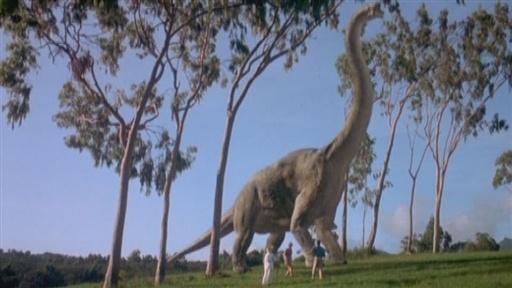
Dinosaurs are a perfect example of this. Who has ever seen a dinosaur? At the same time, who can forget the impact of Jurassic Park's introductory brontosauri? No amount of screen clippery can convey the impact this image had on me as a 13 year old; roughly paraphrased, my impressions were probably along the lines of "Holy crap: a real dinosaur!" And truly, this is the effect that Spielberg's expert technology shot at and achieved that long ago summer, for millions of people all over the world. A real dinosaur - meaning, a dinosaur that made the representations we'd been given in the past appear to be, not awe-inspiring and lifelike, but comical, ridiculous. Dinosaurs are not like that: they're like THIS, and thank god someone finally got them right! So the representation seemed to reach, not just back in time, but forward as well, rendering not only its ancestors, but its children obsolete as well.
In this way, the aesthetic implications of Jurassic Park were, as with all masterstrokes of mimesis, apocalyptic. In order to fully appreciate this, imagine an animator who had working on a dinosaur movie at a rival studio (Disney, for example) seeing those brontosauri for the first time: while the audience gasped, he was no doubt trying to decide which high-rise to throw himself off of - for really what's the point, after such mastery? Where can we possibly go? Hope shuts like an antennae-touched sphincter and the creative brain (which, after all, need hope to function) shrivels into something like dried fruit: something sustaining, in other words, and full of nutrients, but ultimately unsatisfying, like all desert foods.
This feeling, of course, is completely normal: a mix of jealousy, dread and despair that anyone who has ever tried to create something new or at least original has experienced again and again. The history of art is a book of last days: just look at our own chapter if you want proof. Genres are dying, fundamental procedures being re-examined, hallowed formal and extra-formal procedures pushed back by forces that not even the most fervent fundamentalist believes they will be able to overcome. Innovators are heralded as precursors of Mayan-level apocalypses and hold-outs scorned with the cold gaze of opportunistic Bruckheimers peddling their personal 2012s (in which they have decided, despite the promising casting of John Cusack, to stick to the familiar Hollywood disaster-movie formula). Meanwhile, everyone is waiting for the little water glass on the dashboard to start trembling.
III. Last Boat to Kairos
The novel, named for its newness, is gloriously susceptible to these murmurs. As Kermode says:
"Any novel, however 'realistic', involves some degree of alienation from 'reality'. You can see the difficulty Fielding, for example, felt about this, at the very beginning of the serious novel; he felt he had to reject the Richardsonian method of novels by epistolary correspondences, although this made sure that in the midst of voluminous detail intended to ensure realism, everything became kairos [Kermode's appropriation of a Greek word concept of time that is about to end (as opposed to time unoppressed by, for example, a gigantic tidal wave)]."
Fielding debunked the vision of novelistic time that he found in the novel as it had been left to him by previous writers; so he invented a different way of putting things together that he felt was more realistic. The public agreed; but the important word to remember here is "invented". He was making it up. At the same time, the thing he made up appeared, to many people, to be a more accurate (or at least intriguing, beguiling, etc.) representation than what had come before it.
Was Fielding wrong to do this? Actually, Kermode says, he was, in his inventions, being far more the novelist than many of his more derivative contemporaries:
"In short, [Fielding] is, and would have been happy to hear it, of the family of Don Quixote, tilting with a hopeless chivalry against the dull windmills of time-bound reality. All novelists must do so; but it is important that the great ones retreat from reality less perfunctorily than the authors of novelettes and detective stories." (p.51 - and I would advise the reader concerned with the uniquely realistic mimesis of genre fiction to substitute here, for Kermode's somewhat unimaginative "novelettes and detective stories", whatever literature they find most generic)
IV. Hold on to Your Butts
To all those troubled by the coming End, I recommend a re-watching of Jurassic Park. As a meditation on novelty, the movie is endless: a formal and thematic mobius strip, in which the constantly-expressed mistrust of innovation is continually transforming into a delight at newness, or if not newness than at least technology, wittily adapted and charmingly executed (Spielberg's direction being an analogue here of Tom Cruise's smile: irresistible because impenetrable, and impenetrable, not because we can't find our way to the other side of it, but because we feel content to enjoy it as an end, however reduced). I find the velociraptors particularly heartening - for with their green eyes, hunched backs and withered little arms, they are so clearly caricatures that the question of how "real" they look becomes irrelevant, pedantic. Bugs Bunny wouldn't look like that, let alone walk on two legs, let alone talk. Yet he is a persuasive mimesis - if not of a rabbit pure and simple, then perhaps of something (or someone) "rabbity", or perhaps harelike. Animals are riddles - even dinosaurs. Applying them to our lives inevitably involves alterations, infidelities, as all translations do.
Art, like everything, is contextual, and just saying that once-revolutionary innovations now look stupid (or amazing) to us does not absolve us from acknowledging the newest New Thing, even if only by rejecting it. At the same time, my own experience of trying to make is that context can become overwhelming, and that, when this happens, it is helpful to remember that none of us succeed, not even the geniuses. The world goes on, or as A.R. Ammons (who, derivative-sounding when he appeared, has grown since his death into the most experimental American poet) writes:
"the anthology is the moving, changing definition of the
imaginative life of the people, the repository and the source,
genetic: the critic and teacher protect and reveal the source
and watch over the freedom of becomings there: the artist
stands freely into advancings: critics and teacher choose, shape,
and transmit: all three need the widest opening to chance
and possibility, as perceptions that might grow into currents
of mind can find their way; all three are complete men,
centralists and peripheralists who, making, move and stay:" (Sphere, p. 18)
Subscribe to:
Posts (Atom)