
I. Petrified Metaphors
Ponder, if you will: no human being on earth, alive or dead, has ever seen a dinosaur.
In his fantastic exploration of millennial thought, The Sense of an Ending, British literary critic/experimental essayist Frank Kermode examines the concept of "spatialization" in literary criticism, first described by Joseph Frank. Frank's idea, roughly paraphrased by Kermode, seems to be that, while we read a book once "in time", we continue to experience it - through either memory or rereading - in space. Personally, I find this metaphor a little difficult to wrap my mind around (can time and space be isolated like that? Don't we always experience things in both time and space? Could I somehow interact with my living room in a way that doesn't require my moving through time as well? Could I spend an hour outside of space?). What seems crystal clear, however, is the qualifying aside that Kermode appends to it:
"Used in this way 'spatialization' is one of those metaphors which we tend to forget are metaphorical, like the metaphor of organic form." (p. 178)
For me this sentence sums up, among other things, the Novel, Russian literature, and What It Means to Be a Young Man. "One of those metaphors that we tend to forget are metaphorical". Say it with me - go ahead, don't be proud! After all, we're none of us so good at tracking squirrels or carving spoons out of larger spoons that we don't occasionally (read: all the time) treat our metaphors like a teenage boy lavishing backstory on his fake Canadian girlfriend. We're human: mixing up art and life is what we do, whether we're Jan Brady or a brainy Dostoevsky scholar.
II. Real Disasters
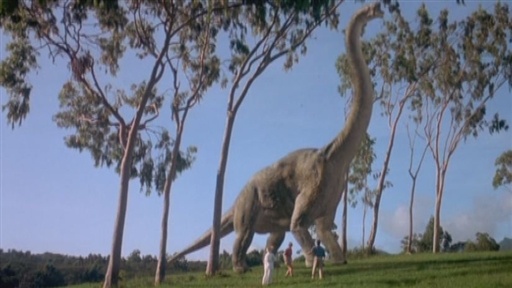
Dinosaurs are a perfect example of this. Who has ever seen a dinosaur? At the same time, who can forget the impact of Jurassic Park's introductory brontosauri? No amount of screen clippery can convey the impact this image had on me as a 13 year old; roughly paraphrased, my impressions were probably along the lines of "Holy crap: a real dinosaur!" And truly, this is the effect that Spielberg's expert technology shot at and achieved that long ago summer, for millions of people all over the world. A real dinosaur - meaning, a dinosaur that made the representations we'd been given in the past appear to be, not awe-inspiring and lifelike, but comical, ridiculous. Dinosaurs are not like that: they're like THIS, and thank god someone finally got them right! So the representation seemed to reach, not just back in time, but forward as well, rendering not only its ancestors, but its children obsolete as well.
In this way, the aesthetic implications of Jurassic Park were, as with all masterstrokes of mimesis, apocalyptic. In order to fully appreciate this, imagine an animator who had working on a dinosaur movie at a rival studio (Disney, for example) seeing those brontosauri for the first time: while the audience gasped, he was no doubt trying to decide which high-rise to throw himself off of - for really what's the point, after such mastery? Where can we possibly go? Hope shuts like an antennae-touched sphincter and the creative brain (which, after all, need hope to function) shrivels into something like dried fruit: something sustaining, in other words, and full of nutrients, but ultimately unsatisfying, like all desert foods.
This feeling, of course, is completely normal: a mix of jealousy, dread and despair that anyone who has ever tried to create something new or at least original has experienced again and again. The history of art is a book of last days: just look at our own chapter if you want proof. Genres are dying, fundamental procedures being re-examined, hallowed formal and extra-formal procedures pushed back by forces that not even the most fervent fundamentalist believes they will be able to overcome. Innovators are heralded as precursors of Mayan-level apocalypses and hold-outs scorned with the cold gaze of opportunistic Bruckheimers peddling their personal 2012s (in which they have decided, despite the promising casting of John Cusack, to stick to the familiar Hollywood disaster-movie formula). Meanwhile, everyone is waiting for the little water glass on the dashboard to start trembling.
III. Last Boat to Kairos
The novel, named for its newness, is gloriously susceptible to these murmurs. As Kermode says:
"Any novel, however 'realistic', involves some degree of alienation from 'reality'. You can see the difficulty Fielding, for example, felt about this, at the very beginning of the serious novel; he felt he had to reject the Richardsonian method of novels by epistolary correspondences, although this made sure that in the midst of voluminous detail intended to ensure realism, everything became kairos [Kermode's appropriation of a Greek word concept of time that is about to end (as opposed to time unoppressed by, for example, a gigantic tidal wave)]."
Fielding debunked the vision of novelistic time that he found in the novel as it had been left to him by previous writers; so he invented a different way of putting things together that he felt was more realistic. The public agreed; but the important word to remember here is "invented". He was making it up. At the same time, the thing he made up appeared, to many people, to be a more accurate (or at least intriguing, beguiling, etc.) representation than what had come before it.
Was Fielding wrong to do this? Actually, Kermode says, he was, in his inventions, being far more the novelist than many of his more derivative contemporaries:
"In short, [Fielding] is, and would have been happy to hear it, of the family of Don Quixote, tilting with a hopeless chivalry against the dull windmills of time-bound reality. All novelists must do so; but it is important that the great ones retreat from reality less perfunctorily than the authors of novelettes and detective stories." (p.51 - and I would advise the reader concerned with the uniquely realistic mimesis of genre fiction to substitute here, for Kermode's somewhat unimaginative "novelettes and detective stories", whatever literature they find most generic)

IV. Hold on to Your Butts
To all those troubled by the coming End, I recommend a re-watching of Jurassic Park. As a meditation on novelty, the movie is endless: a formal and thematic mobius strip, in which the constantly-expressed mistrust of innovation is continually transforming into a delight at newness, or if not newness than at least technology, wittily adapted and charmingly executed (Spielberg's direction being an analogue here of Tom Cruise's smile: irresistible because impenetrable, and impenetrable, not because we can't find our way to the other side of it, but because we feel content to enjoy it as an end, however reduced). I find the velociraptors particularly heartening - for with their green eyes, hunched backs and withered little arms, they are so clearly caricatures that the question of how "real" they look becomes irrelevant, pedantic. Bugs Bunny wouldn't look like that, let alone walk on two legs, let alone talk. Yet he is a persuasive mimesis - if not of a rabbit pure and simple, then perhaps of something (or someone) "rabbity", or perhaps harelike. Animals are riddles - even dinosaurs. Applying them to our lives inevitably involves alterations, infidelities, as all translations do.
Art, like everything, is contextual, and just saying that once-revolutionary innovations now look stupid (or amazing) to us does not absolve us from acknowledging the newest New Thing, even if only by rejecting it. At the same time, my own experience of trying to make is that context can become overwhelming, and that, when this happens, it is helpful to remember that none of us succeed, not even the geniuses. The world goes on, or as A.R. Ammons (who, derivative-sounding when he appeared, has grown since his death into the most experimental American poet) writes:
"the anthology is the moving, changing definition of the
imaginative life of the people, the repository and the source,
genetic: the critic and teacher protect and reveal the source
and watch over the freedom of becomings there: the artist
stands freely into advancings: critics and teacher choose, shape,
and transmit: all three need the widest opening to chance
and possibility, as perceptions that might grow into currents
of mind can find their way; all three are complete men,
centralists and peripheralists who, making, move and stay:" (Sphere, p. 18)


